






Affiliate Disclosure: This article contains affiliate links. If you purchase through these links, I may earn a small commission at no extra cost to you.
RODI (reverse osmosis deionization) water is the foundation of successful reef keeping. Tap water contains chlorine, chloramines, phosphates, nitrates, silicates, and dissolved minerals that accumulate in reef tanks and fuel nuisance algae, stress coral, and destabilize parameters. RODI water removes these contaminants at the source, giving you a clean baseline to build your reef water chemistry from.
This guide covers the best RODI equipment available on Amazon right now: complete systems, storage tanks, replacement filter cartridges, booster pumps, and mineral supplements for freshwater tanks using RODI water. This isn't a single-product category. Building a complete RODI setup requires understanding how the components work together.
Products were selected based on review count, brand reliability, and functional coverage of the complete RODI equipment chain.
Quick Picks
| Product | Best For | Price |
|---|---|---|
| BRS 4-Stage 75 GPD RODI System | Best complete RODI unit for reef tanks | $249.99 |
| AquaticLife Twist-In Replacement Pack | Best replacement filter cartridge set | $74.87 |
| AquaticLife Smart Buddie Booster Pump | Best pressure booster for low-pressure homes | $146.34 |
| APEC 4-Gallon Storage Tank | Best validated RO storage tank | $46.99 |
| Aquatic Life Sediment Filter | Best standalone sediment replacement | $7.88 |
Individual Product Reviews
Complete RODI Systems
Bulk Reef Supply 4-Stage 75 GPD RO/DI System
The most validated complete RODI system on this list from a brand specifically serving reef hobbyists.
Standout features: - 23 reviews at 4.8 stars, strongest validation among the complete systems here - 4-stage filtration: sediment, carbon, RO membrane (75 GPD, 99% efficiency), DI resin - Built-in TDS meter and pressure gauge for real-time water quality monitoring
At $249.99, the Bulk Reef Supply (BRS) 4-Stage Value Plus is the only complete RODI system on this list from a brand that focuses exclusively on reef aquarium equipment. BRS is one of the most respected retailers and content producers in the reef hobby. The 23 reviews at 4.8 stars represent real reef hobbyist validation, not general household water filter users.
The 75 GPD membrane produces up to 75 gallons of purified water per day under ideal conditions (60-80 PSI inlet pressure, room temperature water). In real-world conditions with lower pressure, production drops. The built-in TDS meter lets you monitor post-membrane water quality and DI resin exhaustion in real time without a separate meter. The pressure gauge tracks sediment filter condition.
The auto shutoff solenoid (ASO) and integrated flush valve prevent the system from running to waste continuously when the storage tank is full, extending membrane life. For complete reef tank supplies setups, this is the anchor water production unit.
Pros: - 23 reviews at 4.8 stars, best-validated complete system here - BRS brand built for reef applications specifically - Built-in TDS monitoring and pressure gauge reduce separate equipment needs
Cons: - $249.99 is the highest initial investment on this list - 75 GPD production requires adequate inlet pressure (40-80 PSI minimum) - Storage tank not included, requires separate purchase
Replacement Filter Cartridges
Aquatic Life Twist-In 4-Stage Replacement Cartridge Pack
The most-reviewed replacement cartridge set for standard aquarium RODI systems.
Standout features: - 377 reviews at 4.7 stars, the most validated replacement filter set here - Complete 4-stage set: sediment, carbon block, 75 GPD membrane, DI resin - Designed for Aquatic Life Twist-In systems with 3 and 4-stage RODI configurations
At $74.87, the Aquatic Life Twist-In replacement pack covers all four filter stages in one purchase. For reef hobbyists running an Aquatic Life RODI system, this is the standard annual maintenance purchase. The 377 reviews at 4.7 stars reflect consistent satisfaction across a large user base.
The 75 GPD membrane provides the standard production rate for home reef applications. The color-changing DI resin is a practical monitoring feature: fresh resin is yellow/amber, and exhausted resin turns dark brown/black. Visual resin monitoring tells you exactly when to replace the DI stage without relying on TDS meter readings alone.
Note that the carbon block filter in this set "reduces chlorine but does not remove chloramines." If your municipality uses chloramines rather than chlorine for disinfection, check whether your carbon block is adequate for your water source, as chloramines require either a specific carbon formulation or a KDF/GAC media.
Pros: - 377 reviews at 4.7 stars, strongest replacement filter validation here - Complete 4-stage replacement in one purchase - Color-changing DI resin for visual exhaustion monitoring
Cons: - Carbon block does not remove chloramines, check local water treatment - Designed for Aquatic Life Twist-In systems, not universal - DI resin quality varies with water source TDS levels
AquaticLife RO Buddie Replacement Cartridges (3-Pack)
Replacement cartridges for the Aquatic Life RO Buddie compact system.
Standout features: - 268 reviews at 4.6 stars for a 3-pack covering sediment, carbon, and 50 GPD membrane - 50 GPD TFC membrane with polyamide negative-charge filtration - Carbon block removes 1 PPM chlorine for up to 2,500 gallons
At $46.83 for a 3-pack, the Aquatic Life RO Buddie replacement set covers the three primary filter stages (sediment, carbon, membrane) at an affordable price. This set doesn't include a DI resin stage, making it appropriate for RODI systems that have a separate DI housing or for RO-only systems where full TDS reduction isn't required.
The 50 GPD membrane is lower production than the 75 GPD options elsewhere but appropriate for smaller RODI units. The 268 reviews at 4.6 stars confirm reliable performance across Aquatic Life RO Buddie systems. At $47 for three stages annually, the maintenance cost is accessible.
Pros: - 268 reviews at 4.6 stars, good validation for a replacement cartridge set - Affordable at $46.83 for three filter stages - TFC membrane for effective TDS reduction
Cons: - No DI stage included, not for full TDS-zero water production - 50 GPD production lower than 75 GPD alternatives - Specific to RO Buddie systems, verify compatibility before purchasing
Aquatic Life 5-Micron Sediment Pre-Filter
A replacement 10-inch sediment cartridge for standard RODI systems.
Standout features: - 45 reviews at 4.7 stars for a standard 5-micron sediment replacement - Universal 9-7/8" size fits all standard 10-inch RODI housing - 100% polypropylene true gradient density for extended holding capacity
At $7.88 per cartridge, the Aquatic Life sediment pre-filter is the most affordable item on this list and the most frequently replaced component in any RODI system. Sediment filters are typically replaced every 6-12 months depending on source water particulate content. Some high-sediment water sources require replacement every 3 months.
The 5-micron filtration captures particles down to 5 micrometers, including sand, silt, and rust particles that would otherwise reach and foul the carbon block and RO membrane. The gradient density construction provides extended holding capacity versus uniform density alternatives.
At $8 per filter with 45 reviews at 4.7 stars, this is a validated budget replacement option. The universal 10-inch size means it's compatible with virtually any standard RODI system, not just Aquatic Life units.
Pros: - 45 reviews at 4.7 stars for a $8 replacement filter - Universal 10-inch size fits all standard RODI housings - True gradient density for extended filter life
Cons: - Single-stage replacement only, doesn't cover carbon or membrane - 5-micron rating may need to be stepped down to 1-micron for very sediment-heavy water - Foam pore structure visible at low magnification but functions correctly
RO Storage Tanks
APEC 4-Gallon Pre-Pressurized Storage Tank
The most-reviewed RO storage tank on Amazon, from a well-established water filtration brand.
Standout features: - 3,239 reviews at 4.6 stars, by far the most validated RO storage tank on this list - 4-gallon tank with 3.2-gallon actual storage capacity - Pre-pressurized for efficient discharge, works vertical or horizontal
At $46.99, the APEC Tank-4 is the default recommendation for RO storage tanks based purely on review validation. The 3,239 reviews at 4.6 stars represent years of household and aquarium use across diverse water pressure conditions. APEC is a well-established US water filtration brand with NSF certifications.
The 4-gallon listed capacity with 3.2-gallon actual storage is standard for all RO tanks: the pressurized air bladder inside the tank occupies roughly 20% of the total volume. The pre-pressurized design maintains consistent water delivery pressure as the tank empties.
For reef tank use, a 4-gallon storage tank suits smaller setups (under 50 gallons) or serves as a buffer tank between the RODI system and a larger ATO reservoir. For larger systems requiring 5+ gallons of daily top-off water, a larger tank or direct connection to the ATO reservoir is preferable.
Pros: - 3,239 reviews at 4.6 stars, most-reviewed RO tank by a large margin - APEC brand with established quality and NSF certification - Vertical or horizontal mounting flexibility
Cons: - 3.2 gallon actual storage may be insufficient for large reef systems - 4.6-gallon ceiling is modest versus 5-gallon alternatives - Bladder degradation can occur after several years, requiring tank replacement
Max Water 4.4-Gallon NSF-Certified RO Storage Tank
A heavier-duty 4.4-gallon RO storage tank with NSF certification.
Standout features: - 125 reviews at 4.6 stars, strong validation for a premium storage tank - NSF certified with 100 PSI max working pressure - BPA-free, food-grade plastic components
At $74.95, the Max Water tank costs $28 more than the APEC for similar capacity (4.4 vs 4.0 gallons). The NSF certification and 100 PSI max pressure rating provide more rigorous quality assurance than basic RO tanks. The BPA-free construction meets higher safety standards.
With 125 reviews at 4.6 stars, the Max Water tank has solid validation for a premium storage tank. The pre-charged at 6 PSI design matches the APEC standard. For reef applications where the tank is in a cabinet with limited ventilation, the higher-quality construction provides longer service life.
The honest comparison: the APEC at $46.99 with 3,239 reviews delivers equivalent function at lower cost. The Max Water earns its premium through heavier construction and NSF certification. Choose based on whether you prioritize cost savings or material quality certification.
Pros: - 125 reviews at 4.6 stars, well-validated - NSF certified and 100 PSI rated for rigorous quality standards - BPA-free construction for long-term material safety
Cons: - $74.95 is $28 more than the APEC for marginally more capacity - 4.4-gallon tank still may require larger storage for high-evaporation reef setups - Comparable quality to the APEC at significantly higher cost
AQUA TRUE BLUE 4.5-Gallon RO Storage Tank
A 4.5-gallon RO storage tank with included valve and tubing.
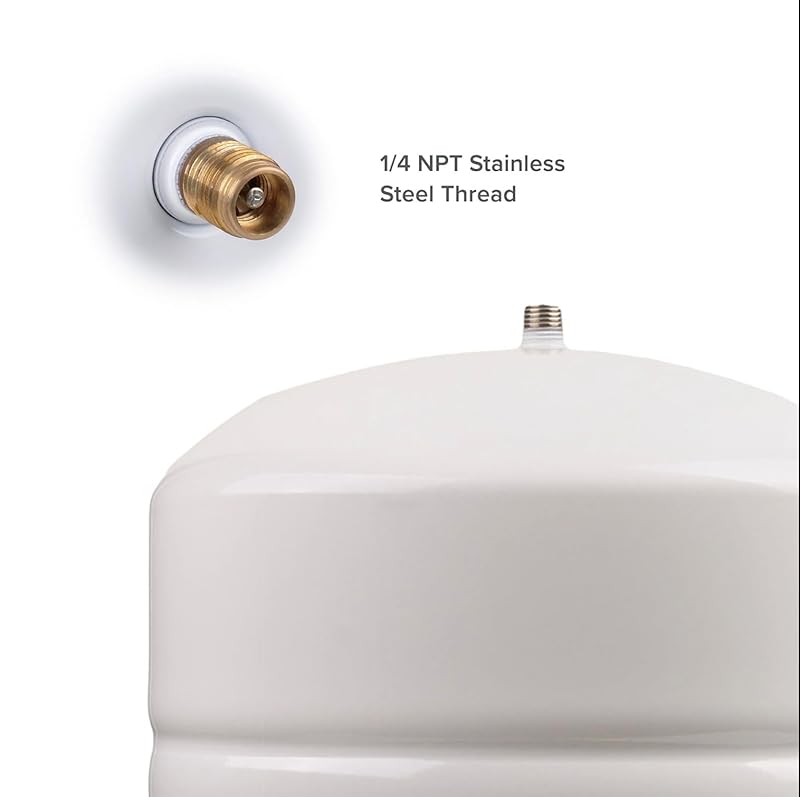
Standout features: - Includes tank ball valve and 4 feet of food-grade tubing - Stainless steel 1/4" NPT connection - 3.2 gallon actual storage capacity
At $64.95 with only 7 reviews at 5 stars, the AQUA TRUE BLUE tank is priced between the APEC ($47) and Max Water ($75). The included valve and tubing add some value over bare-tank alternatives. With 7 reviews, validation is too thin to recommend over the APEC's 3,239-review standard.
The stainless steel connection is a reasonable quality indicator at this price point.
Pros: - Includes valve and 4 feet of tubing for complete setup - Stainless steel connection reduces corrosion risk - Mid-range price between APEC and Max Water
Cons: - Only 7 reviews, insufficient validation compared to APEC alternatives - Same 3.2-gallon actual capacity as the cheaper APEC - No NSF certification mentioned compared to Max Water
Oceanic Water Systems 5.0-Gallon RO Storage Tank
A 5-gallon RO storage tank with NSF certification and 100 PSI max pressure.
Standout features: - 5.0-gallon listed capacity for larger water storage needs - NSF certified with 100 PSI max working pressure - Pre-charged at 7 PSI
At $93.99 with only 1 review at 5 stars, the Oceanic Water Systems 5-gallon tank is the largest storage option here and the most expensive. The 5-gallon capacity is marginally better for larger reef systems than the 4-4.5 gallon alternatives. With 1 review, this is essentially unvalidated on Amazon.
The NSF certification and 100 PSI rating match the Max Water specifications, but the single review count means there's no basis for a confident recommendation over the established alternatives.
Pros: - Largest storage capacity on this list (5 gallons) - NSF certified with 100 PSI max pressure - 4 feet of tubing included for installation
Cons: - Only 1 review, effectively unvalidated - $93.99 is the highest price for a storage tank on this list - No demonstrated advantage over Max Water at $75 beyond marginally more capacity
Booster Pumps and Accessories
AquaticLife Smart Buddie RO Water Booster Pump Kit
The best-reviewed RODI pressure booster pump for homes with low water pressure.
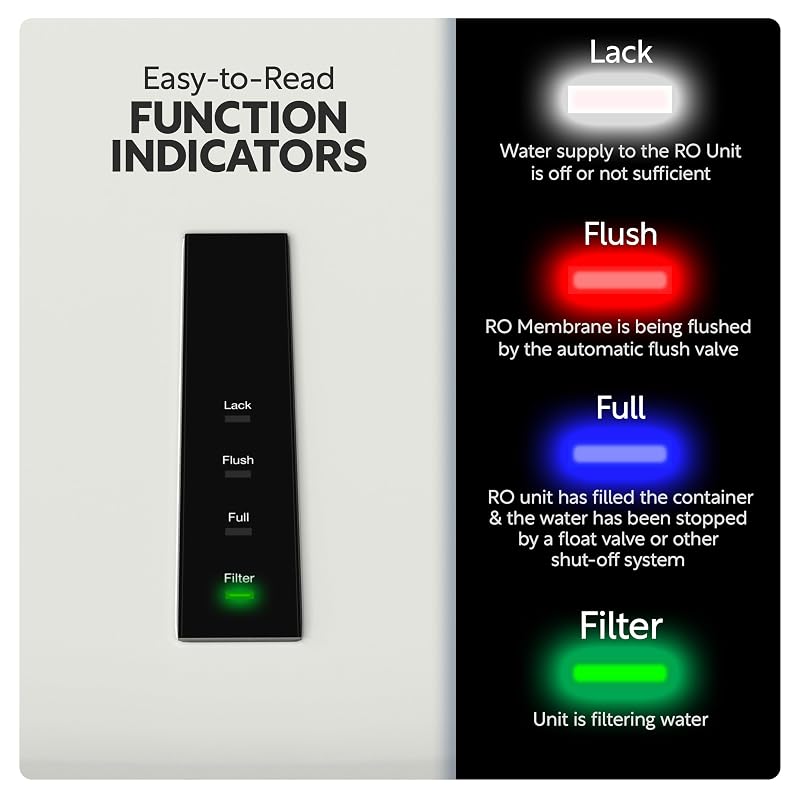
Standout features: - 565 reviews at 4.6 stars, by far the most-validated booster pump here - Boosts inlet pressure to 80 PSI or higher for improved membrane efficiency - Four LED function indicators (LACK, FLUSH, FULL, FILTER) for status monitoring
At $146.34, the AquaticLife Smart Buddie is the standard recommendation for reef hobbyists with low municipal water pressure. RODI systems require at minimum 40 PSI inlet pressure for acceptable membrane performance. Below 40 PSI, the rejection ratio drops, waste water ratio increases, and production slows dramatically. Many homes have 30-50 PSI water pressure, which is borderline.
The Smart Buddie boosts pressure to 80+ PSI, improving membrane efficiency and reducing waste water output. The four LED indicators provide real-time status without requiring manual monitoring. The Buddie Fit press-fittings simplify installation into existing 1/4" RODI plumbing.
With 565 reviews at 4.6 stars, this is the most validated RODI accessory on the list. For reef aquarium supplies setups in homes with low pressure, the booster pump pays for itself in improved filter media life and production consistency.
Pros: - 565 reviews at 4.6 stars, most-validated booster pump - Boosts pressure to 80+ PSI for optimal membrane performance - LED status indicators for passive monitoring
Cons: - $146.34 adds significant cost to the RODI setup investment - Press-fit connections require compatible 1/4" tubing already in use - LED display requires visual inspection rather than remote monitoring
Mineral Supplements for RODI-Based Freshwater
Continuum Aquatics Flora Viv Reconstitute RO
A mineral ion supplement for reconstituting RODI water for freshwater planted tank use.
Standout features: - 34 reviews at 4.7 stars for a comprehensive GH, KH, and trace element supplement - Adds calcium, magnesium, potassium, and essential trace elements to empty RODI water - Specific formulation for freshwater fish, invertebrates, and plants
At $10.82 for 250 grams, the Continuum Flora Viv is a freshwater-specific RODI water reconstitution product. This is relevant primarily for freshwater planted tank users: pure RODI water has zero mineral content, which is good for reef tanks where you add specifically formulated salt, but problematic for freshwater fish that need minerals for osmoregulation.
For freshwater planted tanks using RODI water, a mineral reconstitution product adds back GH (general hardness), KH (carbonate hardness), and trace elements to create a suitable environment. The Continuum Flora Viv's 34 reviews at 4.7 stars give it reasonable validation for the niche application.
For saltwater and reef applications, synthetic salt mix provides all necessary ions when mixed with RODI water. This product is specific to freshwater use.
Pros: - 34 reviews at 4.7 stars for a freshwater RODI reconstitution product - Adds complete mineral ion profile (GH, KH, trace elements) - Affordable at $10.82 for 250 grams
Cons: - Not needed for reef tanks where salt mix provides all ions - Freshwater-specific application limits audience - Dosing precision depends on accurate measurement
Buying Guide: What to Look for in a Reef RODI System
Production rate (GPD) and actual yield. RO membranes are rated in gallons per day (GPD) at specific conditions (77°F water, 60 PSI inlet). In real-world conditions, a 75 GPD membrane might produce 50-60 gallons per day in winter or with lower pressure. For a typical 75-gallon reef tank requiring 1-2 gallons of top-off water daily plus 7-10 gallons for weekly water changes, a 75 GPD membrane is adequate. Larger systems needing 10+ gallons daily benefit from 100 GPD membranes.
TDS monitoring. A built-in or inline TDS meter is essential for tracking three critical data points: incoming tap water TDS (baseline), post-RO membrane TDS (membrane efficiency), and post-DI resin TDS (final water quality). The BRS system includes a built-in TDS meter. For systems without, a $15-25 handheld TDS meter is a worthwhile addition. Target post-DI output of 0-2 ppm TDS for reef use.
DI resin replacement frequency. DI resin lifespan depends entirely on input water quality. Hard water with high TDS exhausts resin faster. Soft water areas may get 6-12 months per resin change. Hard water areas may need resin every 2-3 months. Color-changing DI resin (exhausted resin turns dark) makes monitoring straightforward. Budget for annual or semi-annual resin replacement.
Storage tank sizing. For most home reef applications, a 4-5 gallon storage tank provides a buffer for low-pressure days and overnight top-off water without requiring the system to run continuously. The APEC tank at $47 with 3,239 reviews is the validated standard. For larger systems or ATO setups with permanent RO/DI line connections, the storage tank requirement is reduced since the system fills on demand.
Booster pump necessity. Homes with 40-80 PSI water pressure don't need a booster pump. Homes below 40 PSI do. Check your home water pressure with a simple gauge (under $10) before building an RODI setup. A booster pump adds $146 to the investment but recovers the cost through improved membrane efficiency, lower waste water ratios, and longer filter media life in low-pressure situations.
FAQ
Why do reef tanks need RODI water specifically? Tap water contains chlorine or chloramine (harmful to fish and beneficial bacteria), phosphates and silicates (fuel nuisance algae), nitrates (elevate baseline nitrogen levels), and dissolved minerals that alter water chemistry. RODI removes all of these by passing water through sediment and carbon filtration, then an RO membrane (removes 95-99% of TDS), then a DI resin (removes remaining TDS to zero). Starting with zero TDS water gives precise control over reef water chemistry.
How often do RODI filters need replacement? Sediment filter: every 6-12 months depending on source water. Carbon block: every 6-12 months (some every 2,500-3,000 gallons). RO membrane: every 2-5 years with proper pre-filtration. DI resin: when TDS output rises above 0-2 ppm (varies from 2 months to 12 months depending on input TDS). The TDS meter tells you exactly when the DI resin needs replacement regardless of time elapsed.
What TDS level is acceptable for reef tank water? Target 0 ppm TDS from the DI stage for reef use. At 0-2 ppm, you have essentially pure water for reef salt mixing. Above 5 ppm, TDS indicates DI resin exhaustion and should be replaced before use. Some reefers use a 5 ppm threshold as the replacement trigger.
Can I use RO water without the DI stage for reef tanks? Post-RO membrane water is typically 5-30 ppm TDS depending on your input water and membrane condition. For freshwater aquariums, RO-only water reconstituted with minerals is acceptable. For reef tanks where precise parameter control is critical, the DI stage is recommended to ensure 0 ppm starting TDS. The DI stage also catches any membrane breakthrough and prevents phosphate or silicate residuals from entering the reef.
What's the waste water ratio for RODI systems? Standard RO membranes produce 2-4 gallons of waste water for every 1 gallon of purified water. This ratio improves with higher inlet pressure (which is why booster pumps improve efficiency) and worsens with lower temperature or pressure. Some membranes designed for aquarium use have improved rejection ratios. A permeate pump (different from a booster pump) recycles pressure from the waste stream to improve the ratio.
Can I use RODI water directly without salt mix for reef tanks? No. Pure RODI water is completely mineral-free. Mixing RODI water with reef-grade synthetic salt creates the correct ionic environment for marine life. The salt mix provides all necessary major ions (calcium, magnesium, alkalinity), trace elements, and salinity. For saltwater reef tank supplies setups, the RODI system and quality salt mix work together as the foundation of reef water chemistry.
Conclusion
For a complete RODI system, the Bulk Reef Supply 4-Stage 75 GPD at $249.99 is the best choice. It's the only system on this list purpose-built for reef applications with integrated monitoring and a reef-community brand behind it.
For replacement filter maintenance, the Aquatic Life Twist-In 4-Stage set at $74.87 with 377 reviews is the most validated annual replacement purchase for Aquatic Life systems.
For homes with low water pressure, the AquaticLife Smart Buddie booster pump at $146.34 with 565 reviews is the clear recommendation.
For storage tanks, the APEC 4-gallon at $46.99 with 3,239 reviews is the most validated option. If NSF certification and heavier build quality matter more than cost, the Max Water at $74.95 is the upgrade path.
Also useful for coral health and UV sterilization: see our guides on UV sterilizer reef tank and reef aquarium UV sterilizer systems for additional reef water quality management options.